
How Accurate Are Mammograms? Understanding Missed Breast Cancer Cases
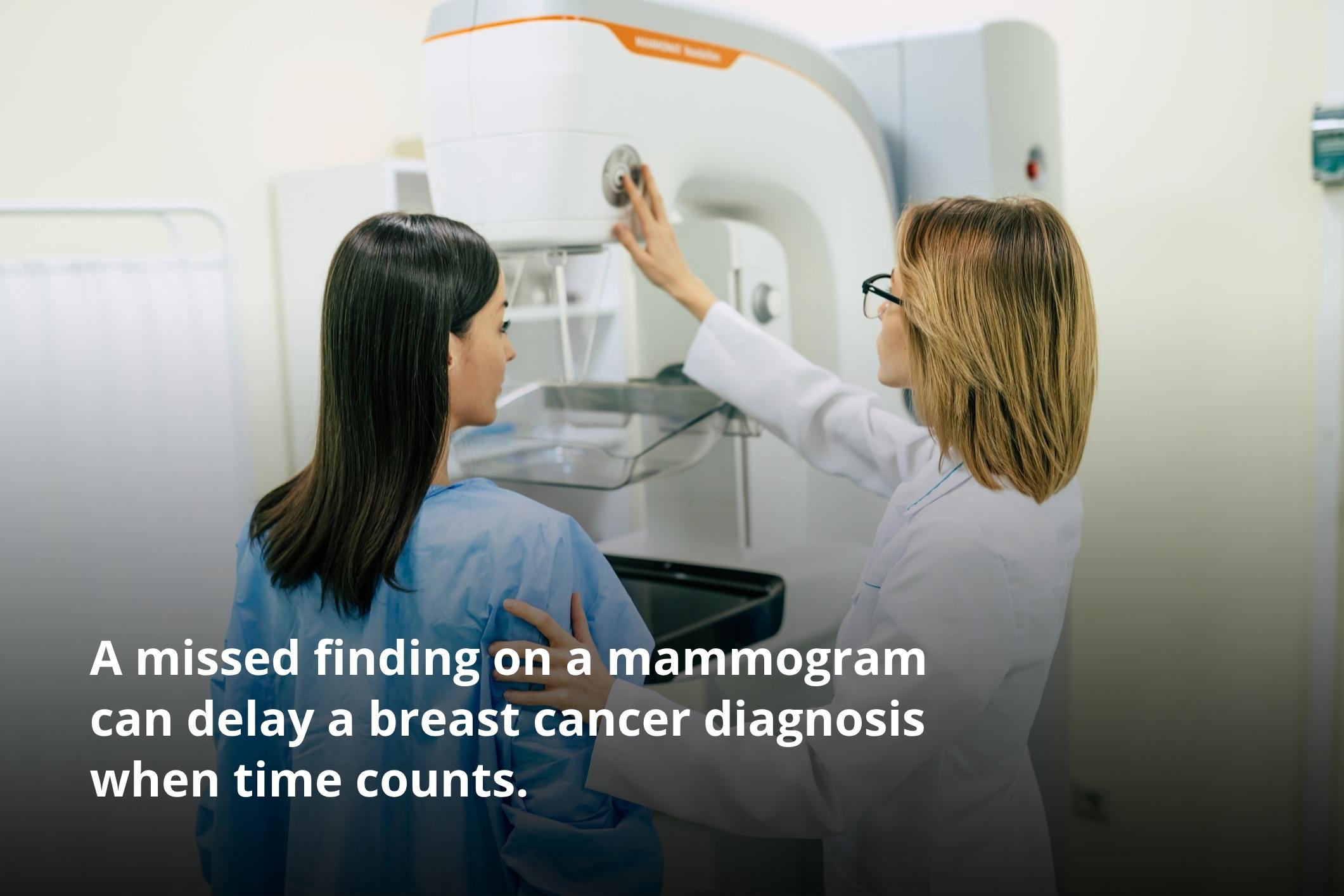
A normal mammogram is reassuring. But it does not guarantee that breast cancer is not there.
Mammography remains the primary screening tool for finding breast cancer early, including tumors that are too small to feel. It also has limits. Some cancers are difficult to see, dense breast tissue can obscure abnormalities, and a finding that appears on the images can be overlooked or interpreted incorrectly.
So, how accurate are mammograms?
The National Cancer Institute reports that mammography sensitivity generally ranges from 70% to 90%, depending on factors involving both the patient and the interpreting radiologist. At an average sensitivity of 80%, about 20% of breast cancers present at the time of screening would be missed.
That does not mean every missed cancer is the result of a medical error. But when a later diagnosis reveals that suspicious changes were visible on an earlier mammogram, questions about how the images were read and what happened afterward deserve answers.
Your mammogram was normal. Now you have breast cancer. If you want to know how that happened, Hodes Milman can help you get answers. Call (949) 640-8222 or contact us online for a free consultation.
How Can a Mammogram Miss Breast Cancer?
Mammograms use low-dose X-rays to look for masses, calcifications, distortions, and other changes in breast tissue. The images are then interpreted by a radiologist, who decides whether the findings appear normal or require additional evaluation.
Several factors affect what appears on those images and how easily an abnormality can be identified. The size and location of a tumor, breast density, image quality, positioning, and the appearance of the cancer itself can all affect detection.
The radiologist's interpretation is another factor. An abnormality can be visible but overlooked, mistaken for benign tissue, or considered unchanged when comparison with earlier imaging shows something different.
That is why the answer to can a mammogram miss breast cancer is yes. The more difficult question is why the cancer was missed.
Dense Breasts Can Make Cancer Harder to See
Breast density has a significant effect on mammography. Dense breasts contain more fibrous and glandular tissue and less fatty tissue, which can make cancers more difficult to distinguish on an X-ray.
The FDA reports that approximately half of women over 40 have dense breasts. Dense breast tissue also increases breast cancer risk.
Since September 2024, federal mammography regulations have required facilities to tell patients whether their breasts are dense. The FDA-required language explains that dense tissue makes breast cancer harder to find on a mammogram and that additional imaging may help find cancers in some patients.
A negative mammogram therefore should not end the evaluation of a suspicious breast symptom simply because the report says no cancer was detected. The National Cancer Institute specifically cautions that a negative mammogram should not discourage additional evaluation when a patient has breast symptoms.
Are Mammograms Accurate When the Result Is Abnormal?
Accuracy involves more than cancers that are missed. Mammography can also identify something suspicious that later turns out not to be cancer.
These are called false-positive results. They can lead to additional mammograms, ultrasound, MRI, or biopsy before cancer is ruled out. A false positive can be stressful, but it is different from a false negative, where cancer is present and the mammogram fails to identify it.
For someone asking are mammograms accurate, both possibilities are relevant. Screening mammography is effective, but the result still has to be considered alongside breast density, symptoms, previous imaging, and individual cancer risk.
What if the Cancer Was Visible on an Earlier Mammogram?
This is where a missed diagnosis begins to look different from the known limitations of mammography.
A woman may be diagnosed with breast cancer and then learn that an earlier mammogram contained a suspicious mass, calcification, asymmetry, or other change. Comparing multiple years of imaging can also show that an abnormality was developing before the diagnosis was finally made.
In breast cancer misdiagnosis cases, medical experts can review the original images rather than relying only on the written reports. They can evaluate whether the finding was reasonably detectable at the time, whether it was interpreted appropriately, and whether additional imaging or biopsy should have followed.
Hodes Milman previously represented a patient whose mammograms were allegedly misinterpreted over several years before her breast cancer diagnosis. The case resolved for $1.75 million.
How Accurate Are Mammogram Results When Compared With Earlier Images?
Prior mammograms give radiologists something valuable: a record of how the breast has changed over time.
A finding that looks unremarkable on one image may look more concerning when compared with a mammogram from the previous year. A mass may have increased in size, an asymmetry may be new, or calcifications may have changed.
The FDA's current mammography rules recognize the importance of prior imaging. One of the permitted assessment categories is “Incomplete: Need prior mammograms for comparison” when the radiologist cannot make a final assessment without earlier studies.
When prior images were available but not reviewed, or a change between studies was missed, that history can become relevant in a misdiagnosis claim.
When Does a Missed Breast Cancer Diagnosis Become Malpractice?
The fact that a mammogram did not detect cancer is not enough by itself to establish malpractice. Mammography has recognized limitations, and some cancers are genuinely difficult to detect.
A medical malpractice case looks at the care the patient actually received. That can involve whether the images were interpreted appropriately, whether earlier mammograms were compared, whether suspicious findings received the recommended follow-up, and whether breast symptoms were investigated despite a negative screening result.
The effect of the delay also has to be examined. Breast cancer can change in stage and spread over time, so medical experts may compare what treatment likely would have been required when the cancer should have been diagnosed with the treatment needed when it was finally found.
Was the cancer visible before you were diagnosed? The answer may be sitting in your earlier mammograms. Hodes Milman works with medical experts who can go back through those images and evaluate what should have been recognized at the time. Call (949) 640-8222 for a free consultation with a cancer misdiagnosis attorney.
What Should You Look at After a Delayed Breast Cancer Diagnosis?
Start with more than the most recent mammogram report. Earlier images, radiology reports, breast-density information, recommendations for additional testing, physician notes, and records of breast symptoms can all be relevant.
The FDA also requires mammography reports to use standardized assessment categories, including negative, benign, probably benign, suspicious, and highly suggestive of malignancy. Reports classified as suspicious or highly suggestive of malignancy are subject to accelerated communication requirements.
Looking across several years of records can show whether a suspicious finding appeared earlier, whether it changed, and what recommendations were made at the time.
In the most serious cases, a delayed diagnosis can allow cancer to progress beyond the point where treatment would have been successful. When medical negligence contributes to a patient's death, surviving family members may also have questions about a wrongful death claim.
Was Your Breast Cancer Missed on an Earlier Mammogram?
Mammograms are an effective breast cancer screening tool, but they are not perfect. When asking how accurate are mammograms, general detection rates cannot tell you what happened in your case. Earlier images can sometimes show that a suspicious finding was present months or even years before the eventual diagnosis.
For someone now facing breast cancer treatment, finding out that an earlier diagnosis was possible can raise serious concerns about the care they received.
Hodes Milman has decades of experience representing patients in medical malpractice cases involving delayed and missed diagnoses. Call (949) 640-8222 or contact us online for a free consultation about your breast cancer diagnosis.
%201.avif)






Dan Hodes treated me like a human being, not just another client. He showed me he cared by how hard he worked on my case.
My daughter was born with a disability due to doctor neglect. I emailed over 200 lawyers over a 2 year time span. I had ONE lawyer believe in my case and he worked with Jeff Milman over the next year helping build my case. Jeff won my case and I cannot thank him enough for believing in me!! He was so pleasant to work with and professional. I will forever be thankful to him and his team!
They are friendly and honest and fought for what they believed was best in our interest.
Proudly Representing California Residents
Your life changed in an instant. Getting justice shouldn’t wait. Connect with Hodes Milman today and put a proven team to work on your case.