
Cerebral Palsy Statistics
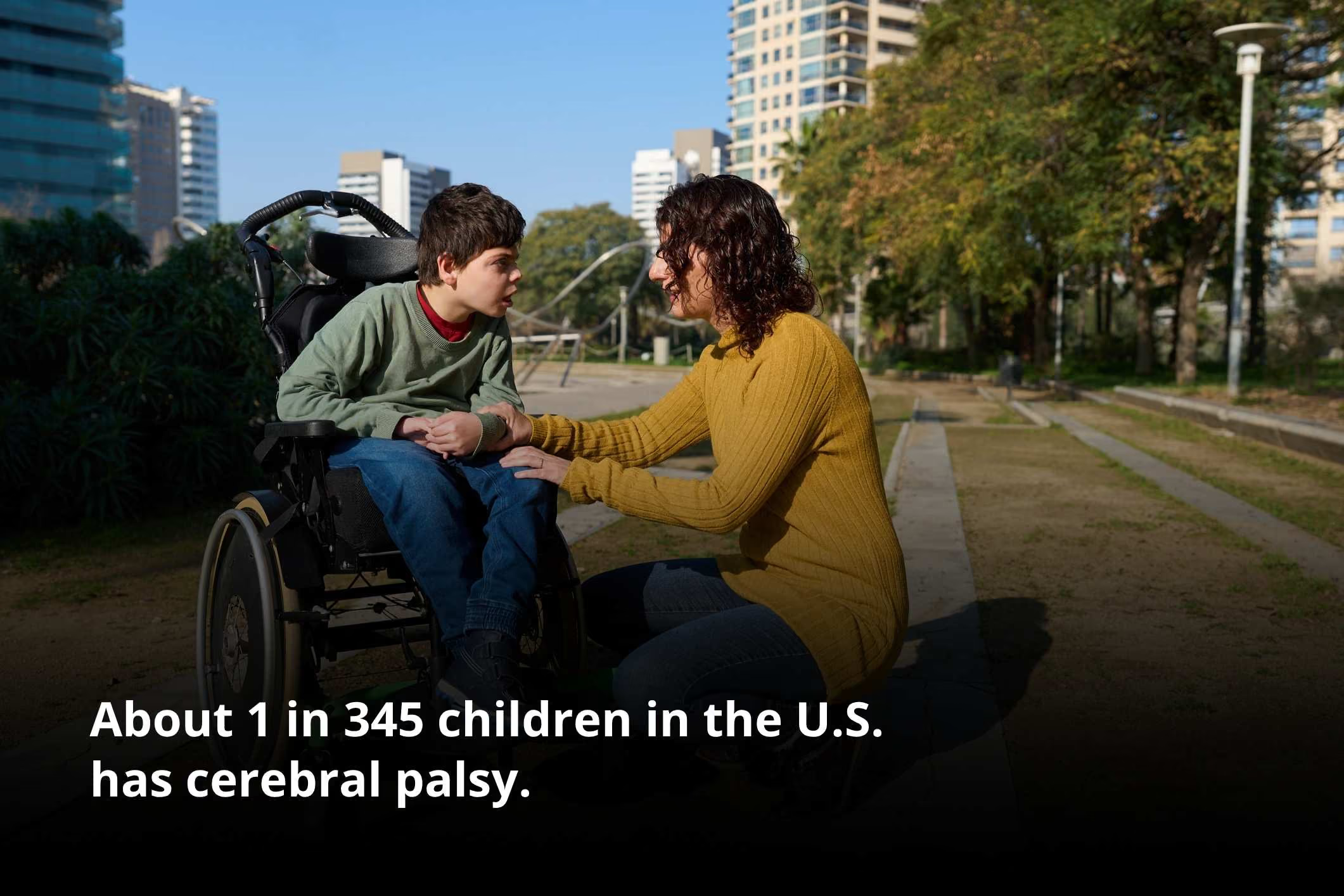
Cerebral palsy is the leading motor disability of childhood, affecting hundreds of thousands of children and adults across the United States. Many families know little about the condition until a diagnosis enters their own home.
The cerebral palsy statistics below offer perspective on how widespread CP is, what leads to it, and the lifelong support it often requires. For a parent facing a new diagnosis, these numbers help frame what comes next and where to turn for help.
Cerebral palsy describes a group of disorders that affect movement, balance, and posture. It develops from abnormal brain development or from damage to the developing brain, often before or during birth. The effects last a lifetime, though they differ from one child to the next.
Reliable data also helps parents separate fact from the fear and misinformation that often follow a diagnosis. It gives a starting point for the questions ahead, from treatment planning to how the injury may have happened.
Free Consultation. If your child's cerebral palsy may be linked to a preventable birth injury, the team at Hodes Milman can help you understand your options. Call (949) 640-8222 for a free, confidential consultation.
How Many Children Are Estimated to Have Cerebral Palsy?
About 1 in 345 children in the United States has been identified with cerebral palsy, according to the Centers for Disease Control and Prevention (CDC).
That works out to close to 3 of every 1,000 eight-year-olds, based on the agency's Autism and Developmental Disabilities Monitoring (ADDM) Network.
CP is the leading motor disability of childhood, and its reach extends well past the early years:
- Worldwide, an estimated 18 million people of all ages live with CP, per the Cerebral Palsy Alliance Research Foundation.
- In the United States, more than 764,000 children and adults have CP, with some recent estimates above one million.
- Each year, roughly 8,000 to 10,000 babies born in the U.S. will develop cerebral palsy.
- Another 1,200 to 1,500 children are diagnosed during their preschool years.
- About 500,000 of those affected in the United States are children under 18.
Because early signs can be subtle, most children are not formally diagnosed until age two or older. Prevalence has held fairly constant across recent decades, even as neonatal care has advanced.
The ADDM Network reaches that 1-in-345 figure by tracking 8-year-olds across selected U.S. communities, which gives researchers a consistent way to compare prevalence over time and across groups.
What Are the Most Frequent Types of Cerebral Palsy?
Cerebral palsy falls into four primary types, defined by how the condition affects muscle tone and movement:
- Spastic CP: stiff muscles and tight, sometimes awkward movements. This is by far the largest group, at roughly 80 percent of cases.
- Dyskinetic CP: uncontrolled, writhing, or jerky movements.
- Ataxic CP: trouble with balance and coordination.
- Mixed CP: signs of more than one type in the same child.
Within spastic CP, doctors further describe which limbs are affected, such as diplegia, which mainly involves the legs, or quadriplegia, which involves all four limbs along with the trunk. The location and degree of involvement guide a child's therapy plan.
Mobility varies just as widely from child to child:
- Roughly half of children with CP can walk independently.
- Others rely on mobility aids or wheelchairs.
- Care teams often use the Gross Motor Function Classification System, a five-level scale, to plan equipment, therapy, and daily support.
These distinctions explain why two children with the same diagnosis can have very different needs.
How Do Cerebral Palsy Rates Differ by Risk Factor?
Prematurity is the strongest predictor of cerebral palsy, and the data shows it plainly. The condition does not strike evenly across all births:
- Full-term babies have a CP rate of roughly 1 to 1.5 per 1,000.
- Premature infants face a risk many times higher, climbing as the birth comes earlier.
- The lower a baby's birthweight, the greater the likelihood of CP.
- Black children show a higher rate, about 3.9 per 1,000, compared with 2.7 per 1,000 among white children.
- Boys are diagnosed more often than girls, at a ratio of about 1.4 to 1.
Registries in Europe and Australia confirm the birthweight relationship across large populations of children. Researchers connect part of the demographic disparity to differences in access to prenatal and neonatal care, and they do not fully understand the gender difference, though some believe the developing male brain may be more vulnerable to early injury.
The longer view offers encouragement. Birth prevalence in high-income countries has fallen to about 1.6 per 1,000 live births, a decline of 30 to 40 percent since the 1990s. Advances in prenatal monitoring, maternal health, and neonatal intensive care account for much of that progress.
Talk to a Birth Injury Attorney
Behind every statistic is a family adjusting to a new reality. If you believe a medical error contributed to your child's diagnosis, Hodes Milman is ready to listen. Reach us online or at (949) 640-8222 for a free case review.
What Do the Statistics of Cerebral Palsy Mean for Families?
The numbers point to a condition that alters daily life and household finances for decades. CP is not progressive, meaning it does not worsen on its own over time, yet it calls for ongoing therapy, equipment, and medical attention from infancy into adulthood.
Cost is one of the starkest measures of that reality:
- The CDC estimates the average lifetime cost of care at roughly $1.6 million in current dollars.
- Other estimates range from $1 million to $5 million, depending on severity.
- Children with CP face annual medical costs about 10 times higher than their peers.
- That figure rises further when an intellectual disability is also present.
These costs land on top of everyday household expenses, which is why financial planning becomes part of caring for a child with CP from an early age.
Many children with CP live with related conditions, including:
- Cognitive impairment, in about 40 percent of cases,
- Epilepsy, in a comparable share, and
- Difficulties with vision, hearing, speech, or feeding.
These layered needs explain why families often coordinate care across many specialists for years.
The effects reach the whole household. Parents may adjust work schedules or leave jobs to manage appointments and therapy, and siblings often take on caregiving roles earlier than their peers.
These cerebral palsy statistics hold a human truth that numbers alone cannot capture. Each diagnosis represents a child whose family is learning to advocate, plan, and adapt, often while managing a cost of care that stretches across a lifetime.
What Is the Long-Term Outlook for People With Cerebral Palsy?
Most children with cerebral palsy live into adulthood, and those with milder forms often have a life expectancy close to the general population. Severity, mobility, feeding ability, and co-occurring conditions are the factors that affect it most.
Studies suggest more than 80 percent of people with CP now live beyond age 58, a figure that has climbed as care has improved.
Adults make up a large share of the CP population today, since survival has improved alongside advances in medical care. Several realities tend to follow the condition across a lifetime:
- Chronic pain is frequent in adulthood. Nearly 75 percent of adults with CP report ongoing pain, often tied to muscle stiffness, joint problems, or hip displacement.
- Independence varies widely. Roughly half of children with CP walk on their own, while about 1 in 3 have limited walking ability or cannot walk without assistance.
- Early therapy makes a difference. Physical, occupational, and speech therapy started young can improve movement, communication, and daily function, even though they do not cure the condition.
- Employment can be affected. One population study found that about two-thirds of people with CP are ar unable to maintain active employment, which adds to the financial strain on families.
These long-term realities are part of why early diagnosis, consistent therapy, and adequate financial resources matter across a person's whole life.
How Can Legal Support Help Families Affected by Cerebral Palsy?
Legal support can help a family recover the cost of care when a preventable medical error caused their child's cerebral palsy. Many cases of CP have no connection to negligence. A portion traces back to mistakes made before, during, or shortly after delivery, and those families have the right to ask hard questions about what happened.
A birth injury attorney can review medical records, consult with medical specialists, and determine whether a delivery team met the accepted standard of care. When a hospital or provider fell short of that standard, a claim can pursue compensation for:
- Therapy and ongoing medical treatment,
- Adaptive equipment and home modifications,
- Lost earning capacity, and
- The lifelong care a child will need.
Building one of these cases takes time and resources. It often calls for obstetric and neurology experts, a detailed review of fetal monitoring records, and a documented timeline of the care a mother and baby received.
Compensation does not change a diagnosis, though it can remove the financial strain that so often compounds it. Birth injury claims also run on strict deadlines, so families benefit from speaking with an attorney early, while records and recollections remain available.
Hodes Milman has represented families in birth injury and cerebral palsy cases for decades, recovering the resources that help children access treatment and support.
Get Answers Today
A cerebral palsy diagnosis changes your family's future, and you should not have to face the financial side of it alone.
If a medical error may have contributed, contact Hodes Milman for a free, confidential consultation. Call (949) 640-8222 or reach out online to speak with our team today.
%201.avif)







Dan Hodes treated me like a human being, not just another client. He showed me he cared by how hard he worked on my case.
My daughter was born with a disability due to doctor neglect. I emailed over 200 lawyers over a 2 year time span. I had ONE lawyer believe in my case and he worked with Jeff Milman over the next year helping build my case. Jeff won my case and I cannot thank him enough for believing in me!! He was so pleasant to work with and professional. I will forever be thankful to him and his team!
They are friendly and honest and fought for what they believed was best in our interest.
Proudly Representing California Residents
Your life changed in an instant. Getting justice shouldn’t wait. Connect with Hodes Milman today and put a proven team to work on your case.